Introduction
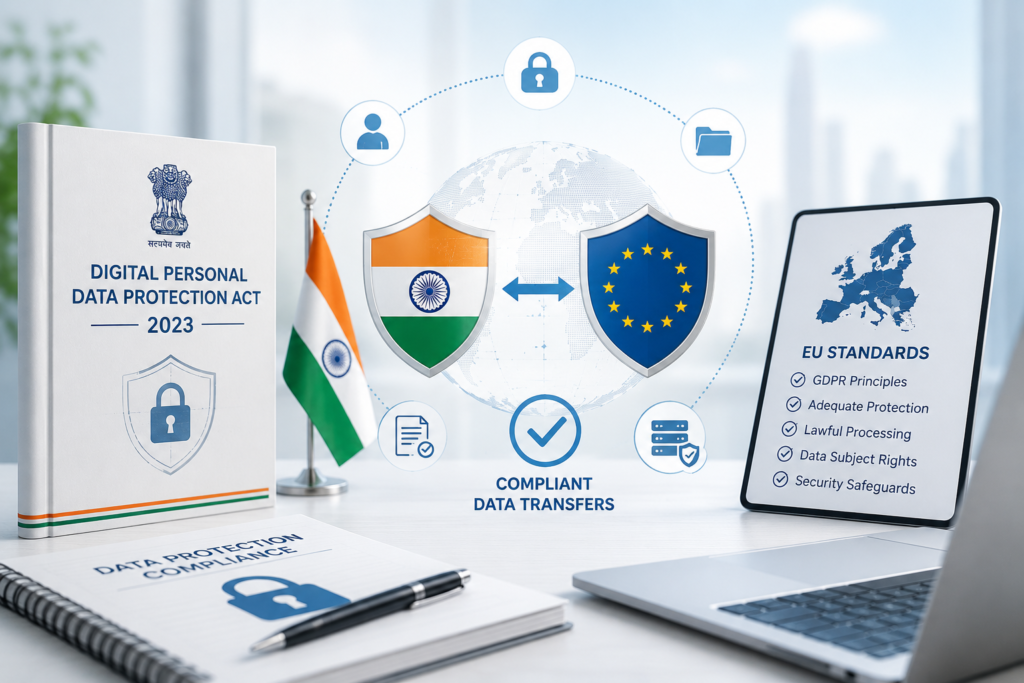
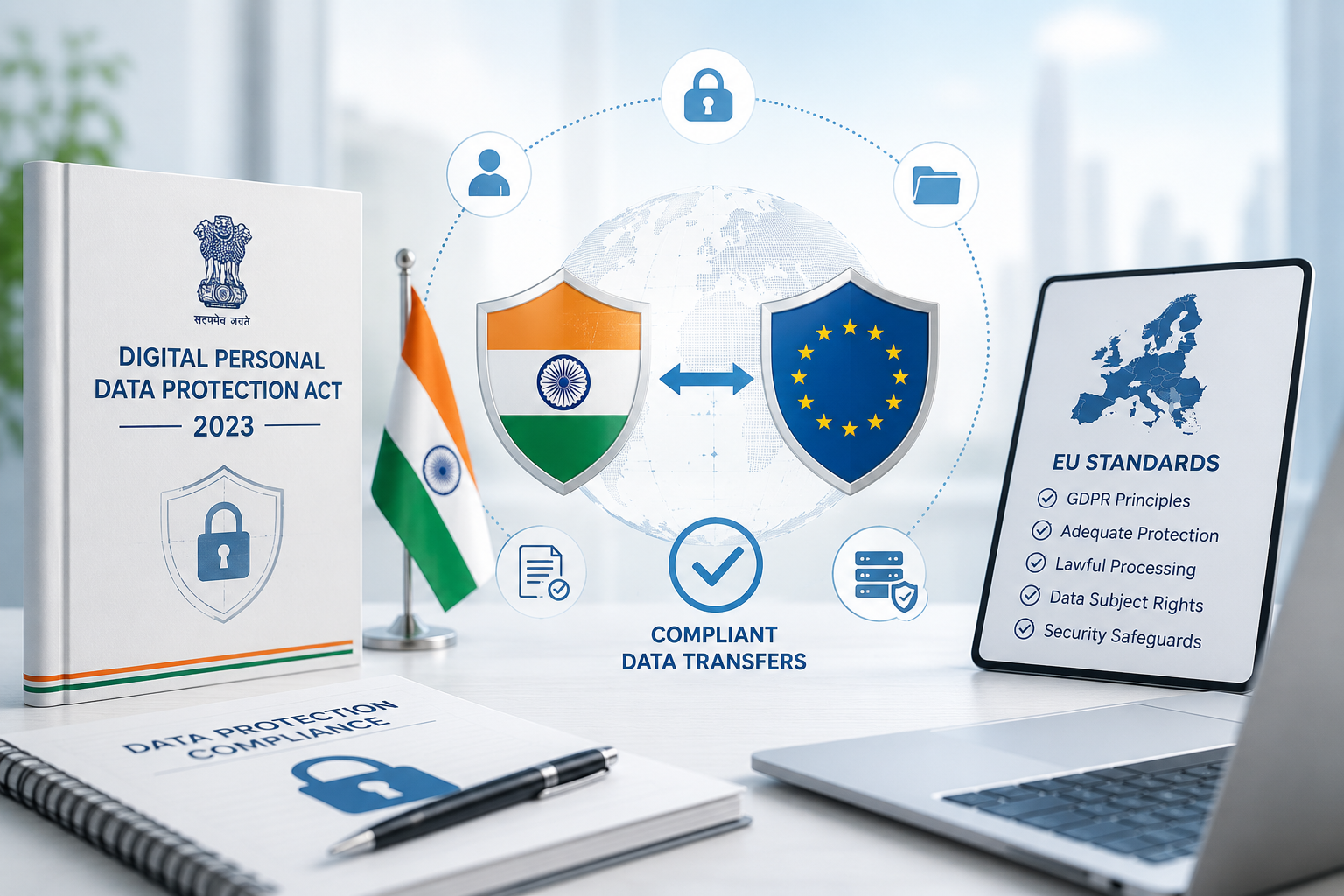
With the rise of online communication, how businesses protect data and privacy has become an important issue of concern for countries across the globe. India took a positive step in protecting personal data by enacting the Digital Personal Data Protection Act (DPDPA) which is a marked step towards data governance in the country. However, for India to participate in data dealings with European Union (EU) Member States, the DPDPA needs to be compliant with the EU’s stringent data protection regulations. Most importantly, it needs to be in sync with the General Data Protection Regulation (GDPR). This paper analyzes the criterions that the European Commission would set on the DPDPA for India to be regarded as an adequate jurisdiction for data transfers for Article 45 of GDPR.
The EU’s Data Protection Framework and Adequacy Decisions
The data protection law passed in 2018, GDPR, stands as one of the most comprehensive law in the world. The European Commission can make an adequacy decision for the GDPR whereby a country outside the EU is deemed to be compliant if they can provide a level of protection to the people’s data that is “essentially equivalent” to that of the GDPR. This equivalence is determined by:
The other country has a strong legal framework and a reasonable system in place where it guarantees basic rights and freedoms in as far as people’s data is concerned.
Enforceable Data Subject Rights: Individuals should have clear rights concerning data access, rectification, and erasure, similar to GDPR’s Articles 12-23.
Independent Supervisory Authority: The presence of an independent body that ensures compliance and addresses grievances is essential.
Judicial Redress and Remedies: Data subjects must have accessible legal remedies for violations of their privacy rights.
Restrictions on Government Access: Any government surveillance or access to personal data should be necessary, proportionate, and subject to oversight.
India’s Digital Personal Data Protection Act (DPDPA) and Its Provisions
The DPDPA, enacted in 2023, aims to regulate the collection, processing, and transfer of personal data in India. Key provisions include:
1. The DPDPA allows data processing only when individuals provide clear consent expressly and with all necessary information about data handling except in situations demanding legal compliance or public interest. The data processing consent requirements follow Article 6 of GDPR yet the extended provisions for legitimate interests which GDPR contains are absent.
2. Individuals receive three fundamental rights through the Act which include obtaining access to their personal data and making necessary data changes and requesting data erasure. The enforcement system of the DPDPA rights remains unclear because the Act lacks robust rectification and deletion protocols although it provides the same data subject rights as the GDPR under Articles 16 and 17.
3. Under the DPDPA Data Fiduciaries must fulfill certain strict obligations when they process personal data. Data fiduciaries must practice data minimization and storage limitations while setting appropriate security measures in their processes. Recipients of large-scale data processing must implement two additional duties which mirror GDPR standards including selection of Data Protection Officers and completion of regular Data Protection Impact Assessments.
4. Complaints and regulatory compliance enforcement belongs to the Data Protection Board according to the DPDPA standards. The DPDPA faces criticism regarding its independence from central government appointees because the supervisory bodies under GDPR need to function autonomously (Article 51).
5. The DPDPA differs from GDPR concerning data transfer regulations by permitting Indian government approval of foreign nations receiving data but avoiding GDPR standards for international information sharing. The absence of predetermined adequacy criteria in operation reduces forecastability of data transfers when compared to the GDPR’s adequacy decisions and standard contractual clauses and binding corporate rules.Government Exemptions One of the most debated aspects of the DPDPA is the extensive exemptions granted to the government for processing data in the interest of national security, law enforcement, and public order. Unlike the GDPR, which mandates that any restrictions on data subject rights must be necessary and proportionate (Article 23), the DPDPA does not clearly define the scope and limits of these exemptions, raising concerns about potential misuse.
Key Areas of Concern for EU Adequacy Assessment
1. Government Surveillance and Exemptiaons
The European Commission determines if official access to data meets basic requirements of necessity while being balanced. Under the DPDPA national security considerations as well as law enforcement needs obtain substantial exemptions which grant extensive access to personal data. GDPR poses issues alongside the Court of Justice of the EU’s Schrems I and Schrems II decisions which dismissed the Privacy Shield because of excessive government monitoring practices
2. Independence of the Data Protection Authority
The DPDPA introduces a Data Protection Board by law yet its independence faces doubts because government appoints all its members. Under the GDPR supervisory authorities need entire independence according to Article 51.
3. Data Subject Rights and Remedies
Subject data under the DPDPA has comparable rights to GDPR but struggles with precise remedies for government-related decisions. The European Commission will insist on requiring India to implement stricter legal systems of redress due to the weak current provisions.
4. Data Transfer Mechanisms and Adequacy Standards
Under the DPDPA the Indian government maintains extensive freedom to control data transfer activities because the regulation lacks strict transfer requirements (Articles 46-49) found in GDPR. European Union authorities require India to create specific protective measures which equate to GDPR regulations.
Comparative Analysis: Other Jurisdictions and Adequacy Status
The European Union provides adequacy decisions to nations such as Japan, South Korea and the UK but these countries need to implement supplementary GDPR-compliant measures. The Japanese authorities implemented the Supplementary Rules to address GDPR gaps. The data autonomy body of South Korea received additional strengthening power from reforms. The Indian authorities should consider implementing complementary legislation that meets EU approval requirements.
Recommendations for India’s Compliance
1.India should establish proportionate oversight systems to verify valid and essential government access to data. An independent judicial body together with parliamentary review must operate to block unnecessary or improper surveillance procedures from being carried out.
2.The independence of the Data Protection Board requires fortification as it serves as an essential element for proper functioning. A transparent multi-stakeholder process should be used to select board members directly instead of government officials because impartial enforcement of data protection laws requires independent appointees.
3.The Indian government must create specific court-backed systems which enable citizens to fight against data breaches and unlawful government data interference. Data protection tribunals should function independently as an official remedy system that enables individuals to file their cases with higher courts.
4.The DPDPA must implement explicit adequacy standards for validating data transfer agreements which require equivalent protection standards from recipient countries. India should implement data transfer methods like Standard Contractual Clauses (SCCs) and Binding Corporate Rules (BCRs) as these align with the GDPR for legal international data exchanges.
Conclusion
The data protection framework in India through its DPDPA has already taken significant strides but must be updated to achieve EU conformance standards. Strategic priorities between India and the EU regarding data transfer require Indian law to undergo changes and institutional updates to fulfill GDPR compliance requirements. The European Commission will issue an adequacy decision for India only when India resolves issues related to government surveillance and regulatory independence and establish enforceable rights.
References
1. General Data Protection Regulation (EU) 2016/679
2. Digital Personal Data Protection Act, 2023 (India)
3. Schrems I [2015] ECLI:EU:C:2015:650
4. Schrems II [2020] ECLI:EU:C:2020:559
5. European Commission, ‘Adequacy decisions’ (ec.europa.eu, 2023) https://ec.europa.eu/info/law/law-topic/data-protection/international-dimension-data-protection/adequacy-decisions
6. Data Protection Act, 2018 (UK)