Introduction
Intellectual Property rights are considered as a significant asset in the arena of international trade and investment. Disputes between the states and investors over IP laws has increased as globalization promotes investments among states over various sectors such as pharmaceuticals and technology. More directly, foreign investors are using the Investor-State Dispute Settlement (ISDS) mechanisms to challenge state actions that they claim contravene international IP law or impair the value of their IP rights.
This raises two essential questions:
- Can investors resort to ISDS mechanisms to raise the query of whether states are actually adhering to international IP law?
- Should investment arbitration courts be allowed to cite reasons for domestic or foreign intellectual property laws when resolving issues?
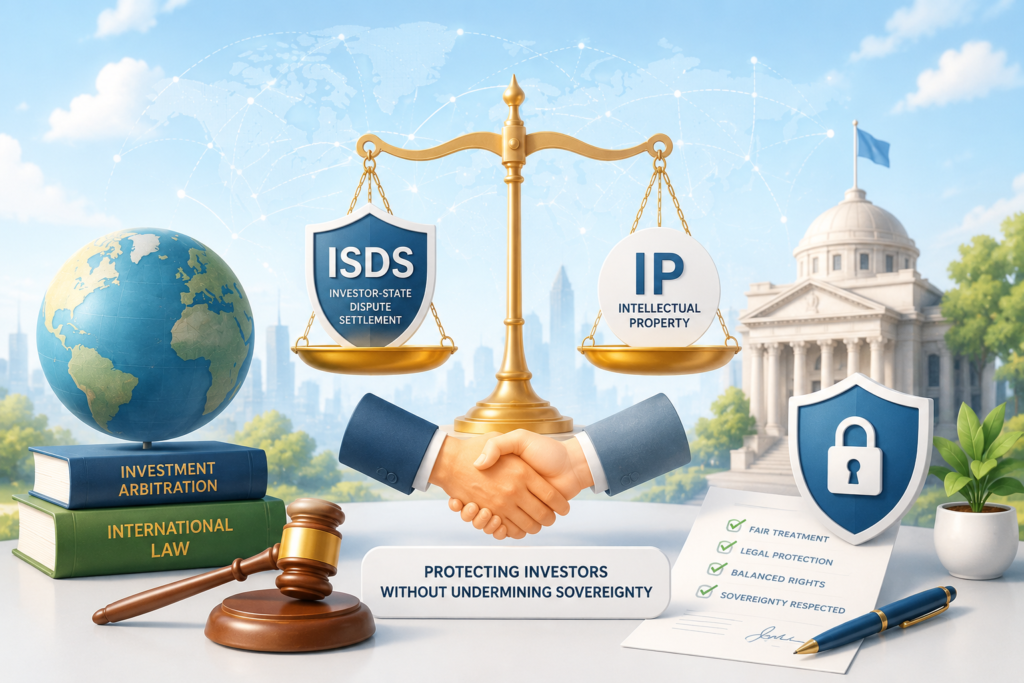
The present answer investigates the mentioned issues, observing the mode through which ISDS functions regarding IP-related disputes, and its implications on public policy and sovereignty, as well as the problems that rise from investment tribunals interpreting IP laws. Therefore, this essay argues that even though ISDS forms a valid place for protecting the IP rights of investors, their use must be carefully controlled to maintain a balance between protecting investors and state sovereignty.
History: IP Disputes and ISDS
Role of ISDS in safeguarding Foreign investments
ISDS mechanisms, which appear frequently in BITs and MITs, permit host countries to be sued directly by foreign investors for alleged treaty breaches. That is, this mechanism seeks:
- To afford investors a neutral and predictable forum within which they may seek redress.
- Protect investments from discriminatory, arbitrary or expropriatory state actions.
The rights under patents, trademarks, copyrights, and trade secrets are being treated as more “investments” under these treaties. For instance, the US Model BIT and the Energy Charter Treaty specifically list IP rights as among protected investments[1].
IP related ISDS disputes
IP disputes under ISDS frequently arise when a state takes actions perceived to undermine foreign investors’ IP rights, including the following:
- Compulsory licensing of patents during public health crises (e.g., for life-saving drugs).
- Invalidation of patents or trademarks by judicial or administrative action.
- Expropriation or indirect expropriation of IP rights, such as nullifying exclusive rights.
- Failure to enforce IP rights in a manner consistent with international treaties like the TRIPS Agreement.
In the case of Philip Morris v. Uruguay[2], Philip Morris challenged the tobacco packaging regulations of Uruguay on the account that such measure expropriated its trademarks and breached the FET standard. Howbeit. The tribunal upheld the actions of Uruguay on account that the state has the right to implement measures for public health. In Eli Lilly v. Canada[3], Eli Lilly challenged Canadian judicial decisions of disapproving two of its patents. It was argued that such decision amount to indirect expropriation and violated its legitimate expectations under NAFTA. However, the tribunal dismissed the claims of Eli and approved the state’s judicial independence. In Bridgestone Licensing Services v. Panama[4], Bridgestone argued that a judgment of the Supreme Court of Panama holding it liable for trademark infringement breached FET under the US-Panama Trade Promotion Agreement. These cases demonstrate how ISDS is a platform for intellectual property related disputes[5].
Should Investors Challenge State Compliance with International IP Laws Through ISDS?
Protection against unfair treatment. ISDS allows foreign investors to appeal the government’s action that might have adversely or illegally infringed on their rights in intellectual property. For instance, if a government introduces unfair regulations against the owners of foreign IP, ISDS allows investors to claim relief to ensure that such rights are not prejudiced by such unfair policies.
A Fair and Binding Place to Resolve Disputes. In many places, local courts may not be independent or skilled enough in complicated IP and investment disputes. ISDS provides a neutral space for solving these disputes, lowering the chance of unfair treatment against foreign investors.
Encouraging compliance with international obligations. ISDS can also become a means of holding the states accountable to breach international IP treaties, for example, the WTO TRIPS Agreement, in respect of compliance with international standards of IP.
Dangers of Undermining Public Policy. IP is not only a private right but also a means to support public goals such as health, education, and innovation. The public interest may be undermined in the sense that ISDS may yield to private profits rather than societal needs. For instance:
- Compulsory Licensing: Investors may challenge the use of TRIPS flexibilities, such as compulsory licensing for medicines, thereby discouraging states from taking measures to address public health crises.
- Regulatory Chill: States might not engage in IP-related policies such as price control and access to medicine owing to the risk of an ISDS claim[6].
International Law. ISDS tribunals function independently of other international legal systems, such as the WTO dispute settlement system. Allowing investors to inquire about how states implement international IP law may lead to different understandings of treaties like TRIPS, creating confusion in the law.
Effect on State Control. Most often, intellectual property disputes involve choices that are critical for regulation. When investors can challenge such choices under ISDS, countries may lose power to make rules regarding public health, education, and innovation[7].
Lack of expertise. The tribunals on investment are composed of arbitrators holding a background in investment law, not in IP law. Therefore, an opportunity for an error or inconsistent decision based on such issues may arise.
Should Investment Tribunals Interpret Domestic or International IP Laws?
Investment Tribunals and Domestic IP Law. Cases concerning the implementation of local laws on IP are generally brought before investment tribunals. Their possible application in interpreting local law poses several problems, however:
Venture into Supra-National Court. Investment tribunals are neither appellate courts for the different national legal systems. Giving them the powers to interpret such local IP laws contravenes the principles of national judicial independence. For instance, in Eli Lilly v. Canada, the investor sought to appeal judgments issued by Canadian courts that anulled its patents. The arbitration tribunal ruled in favor of the principle that national laws are best interpreted by local courts.
Limited Domestic Legal Knowledge. Arbitrators often lack the expertise or the context to fully understand domestic IP laws and thus can err in their interpretations or overstep.
Investment Tribunals and International IP Law
Investment tribunals may have to explain international IP agreements such as TRIPS. That creates additional difficulties,
Possible Conflicts with WTO Decisions. The WTO dispute settlement is the central forum for settlement of disputes over TRIPS. Interpretation of TRIPS by investment tribunals may lead to disparate decisions that could negatively affect the consistency of international IP law. For instance, a WTO panel may hold that a state’s compulsory licensing provisions are permissible under TRIPS, and an investment tribunal may then find that the same measure is expropriatory.
Lack of Jurisdiction. Investment tribunals are established to resolve disputes under investment treaties, not to determine the compliance with international IP agreements. Their interpretation of TRIPS or other IP treaties may exceed their jurisdiction[8].
Risk of Unbalanced Outcome. Investment tribunals are usually investor-protecting. This may shift their perception of international IP laws, thus upsetting the balance that TRIPS was designed to create.
Regulating ISDS in IP-Related Disputes
Clarifying the Scope of Investment Treaties. States may provide clear provisions within investment treaties that:
- Delineate the scope of IP-related protections.
- Carve out specific disputes, including compulsory licensing, from the scope of ISDS.
- Confirm that a state remains free to regulate IP based on public policy reasons.
Deference to Domestic and International IP Law. Investment tribunals should:
- defer to the decision of the domestic courts regarding domestic IP law
- defer to the first instance jurisdiction of the WTO panels on matters concerning the TRIPS dispute.
- This must be understood in the context of international IP law and what is available under TRIPS.
Enhancing Arbitrator Expertise. Tribunal bodies handling IP should have experts in IP cases to achieve just and informed arbitral rulings.
Encourage Multilateral Cooperation. Increased communication between the WTO, WIPO (World Intellectual Property Organization), and ISDS mechanisms will help increase coherence and consistency in the interpretation of issues related to intellectual property[9].
Conclusion
Thus, use of ISDS to challenge state measures with international Intellectual Property law is a controversial issue. Though ISDS supports foreign investors to protect their Intellectual Property rights, it still possess an unregulated application risk which undermines the public policy objectives. International law and infringement on the state sovereignty. The investment tribunals should act merely as courts of domestic and international IP law jurisdiction and not serve as an appeal forum to domestic courts; they ought not to be a forum of substitution for interpreting International IP instruments such as TRIPS. This can be done in several ways: making plain what constitutes the scope of IP protection, keeping sensitive disputes out of ISDS and affirming state regulatory autonomy. The mentioned measures would give ISDS the capacity to complement and not conflict with the balance achieved within international IP law.
1 Simon Klopschinski, Christopher S. Gibson, et.al., ‘The Protection of Intellectual Property Rights under International Investment Law, Oxford International Arbitration Series’ (2021) Oxford University Press 2021.
2 Philip Morris Brand SARL, Philip Morris Products S.A. and Abal Hermanos S.A. v. Oriental Republic of Uruguay, ICSID Case No. ARB/10/7.
3 Eli Lilly and Company v. Canada, ICSID Case No. UNCT/14/2.
4 Bridgestone Americas, Inc. and Bridgestone Licensing Services, Inc. v. Republic of Panama, ICSID Case No. ARB/16/34.
5 Anthea Roberts, “Incremental, Systemic, and Paradigmatic Reform of Investor-State Arbitration” (2018) American Journal of International Law 410.
6 Dolzer, R., & Schreuer, C, “ Principles of International Investment Law” (2012) Oxford University Press.
7 Correa C. M., ‘Investment protection in bilateral and free trade agreements: implications for the granting of compulsory licenses‘ (2004) 26 Michigan Journal of International Law 331.
8 Pugatch M.P., ‗The International Regulation of IPRs in a TRIPS and TRIPS-plus World‘ (2005) 6(3) Journal of World Investment 431.
9 OECD (2004), ‗Relationship between International Investment Agreements (May 2004)‘, Working Papers on International Investment, Number 2004/1, available at http://www.oecd.org/dataoecd/8/43/31784519.pdf.